
Views: 0 Author: Site Editor Publish Time: 2026-02-24 Origin: Site


In the competitive landscape of modern sleep technology, the efficiency of your assembly line often dictates your profit margins. For many manufacturers, the manual positioning of foam layers remains a persistent bottleneck, causing inconsistent alignment, excessive adhesive waste, and cycle times that fail to meet market demand. The solution lies in integrating a robust Automatic Sponge Feeding Machine into your production floor. This equipment functions as more than a simple conveyor; it serves as a precision integration layer connecting foaming, cutting, and final assembly stations.
By adopting this technology, factories can transition from labor-heavy operations to "unmanned workshop" capabilities. This shift moves production away from manual variability and toward standardized industrial precision. In the following sections, we will explore how this equipment optimizes throughput and why it is becoming a standard requirement for scalable mattress manufacturing.
Cycle Time Reduction: How automation pushes production speeds to ≤60 seconds per mattress (industry benchmark).
Labor Reallocation: Moving from manual lifting/positioning to supervision; reducing assembly line headcount by up to 50%.
Material Savings: The impact of intelligent positioning on reducing glue usage and foam scrap rates.
Integration Readiness: Why MES/ERP compatibility and modular design are now non-negotiable for future-proofing.
Every plant manager knows the inherent trade-off in manual assembly: speed usually sacrifices accuracy. When workers rush to meet daily quotas, foam layers are often placed slightly off-center. This misalignment forces downstream operators to pause and adjust, creating micro-stoppages that accumulate into significant downtime. Conversely, slowing down to ensure perfect alignment kills your throughput.
Automation eliminates this compromise. A modern High-speed foam feeding machine decouples speed from accuracy using automated friction-belt systems and robotic correctors. These systems maintain consistent velocity while ensuring layers are placed with exact coordinates.
The critical metric to watch here is alignment precision. Leading systems offer precision within ±3mm even when operating at full speed. This level of accuracy is virtually impossible for human teams to sustain over an eight-hour shift.
Material handling presents another layer of complexity. Modern hybrid mattresses utilize a vast array of foam densities, ranging from light 6kg/m³ quilting foams to dense 80kg/m³ support cores. Manual handling of lighter, softer layers often results in stretching, tearing, or fingerprint indentations.
Automated feeders utilize controlled tension settings to transport these materials without distortion. Sensors detect the material type and adjust the belt speed and grip pressure accordingly, ensuring the integrity of delicate memory foam or latex layers.
Beyond the product itself, the human element drives the need for automation. Lifting heavy foam cores repeatedly leads to worker fatigue and injury. Furthermore, manual glue application exposes staff to adhesive fumes, particularly when using hot melt systems. Automation encloses these processes, significantly reducing worker exposure and creating a safer, more sustainable shop floor environment.
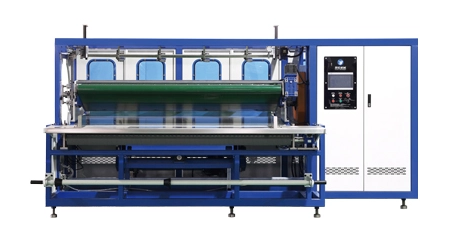
To understand the value of these machines, you must look under the hood. The difference between a standard conveyor and a smart system lies in three core technology layers: vision, mechanics, and robotics.
Advanced Intelligent sponge positioning machine models utilize AI vision or dual-position sensors to correct foam orientation in real-time. As a foam sheet approaches the assembly area, cameras analyze its edges. If the sheet is skewed, the system calculates the necessary adjustment and directs the mechanical guides to realign it before it reaches the gluing station.
For facilities producing custom or hybrid orders, RFID technology plays a pivotal role. RFID chips embedded in pallets or tracked via the production software allow the machine to identify which specific foam layer is incoming. This ensures the correct glue pattern is applied and the layer is stacked in the right sequence.
The belts moving the foam are as critical as the software controlling them. You will typically encounter two specific design choices intended to solve production headaches:
Silicone vs. Standard Belts: In glue spraying stations, standard belts become sticky and dirty quickly. Premium machines use anti-stick silicone belts. This prevents adhesive residue buildup, reducing cleaning downtime and preventing stray glue from ruining the bottom of a mattress.
Anti-Slip Designs: High-acceleration transfers require stability. Textured or vacuum-assist belts prevent the foam from slipping when the conveyor ramps up speed, ensuring the material location data remains accurate.
The actual stacking and placement are often handled by robotic integration. There are two main approaches:
Truss-Type Spreaders: These are cost-effective, gantry-style systems ideal for straightforward stacking operations. They are fast and reliable for standard square or rectangular mattresses.
6-Axis Robots (e.g., KUKA): These offer high flexibility. They can flip mattresses, handle complex shapes, and work in tighter spaces.
A "Dual-Station Logic" setup is highly recommended for maximizing ROI. In this configuration (often called A/B station setup), a single robot sits between two conveyor lines. While Line A is moving or curing, the robot services Line B. This keeps the expensive robotic arm in constant motion, effectively doubling its utility.
Selecting the right Mattress assembly equipment requires looking beyond the marketing brochure. You need to evaluate how the machine fits into your specific ecosystem.
Your feeding machine must match or slightly exceed the speed of your fastest upstream or downstream process. If your tape edge machine can finish a mattress in 60 seconds, your feeding and stacking cycle must support that pace.
Demand verifiable data from manufacturers. Ask specific questions: "Does this machine support a ≤30-second stacking cycle?" or "Is the 1-minute cycle for full assembly or just feeding?" Matching machine speed to your existing quilting outputs prevents the creation of new bottlenecks.
Future-proofing is essential. Look for "Series Connection" capabilities. You might only need a feeder and stacker today, but you may want to add a second gluing module or a flipping station next year. Modular systems allow you to bolt on new capabilities without scrapping the original line.
Physical Footprint Table: Standard Module Estimations
| Module Type | Typical Dimensions (L x W) | Space Consideration |
|---|---|---|
| Single Station Feeder | 6m x 3m | Requires buffer zone for forklifts. |
| Full Assembly Line (Glue + Stack) | 15m x 8.5m | Needs clearance for maintenance access. |
| Robot Cell (6-Axis) | 4m x 4m (Cage) | Height clearance usually >4.5m required. |
Modern manufacturing runs on data. Check for open API or MES (Manufacturing Execution System) interfaces. A smart machine should report its status, downtime reasons, material usage, and error codes to a central dashboard.
Recipe storage is another non-negotiable feature. The system should store 100+ product specifications (recipes). This allows operators to switch from producing a "Queen Size Firm" to a "King Size Plush" instantly via the HMI (Human-Machine Interface), rather than manually recalibrating mechanical guides.
The initial purchase price is only one component of the Total Cost of Ownership (TCO). The real financial value of automation becomes apparent when analyzing operational efficiencies.
Glue consumption is a massive recurring cost. Manual spray operators often overspray to ensure a secure bond, leading to waste. Automated trajectories are precise and consistent.
Whether you integrate water-based or hot melt glue systems, automation typically reduces glue consumption by 15-20%. Over a year of high-volume production, this material saving alone can often amortize a significant portion of the machine's cost.
Consider the economics of your current line. A typical manual assembly station might require four people: two to lift and place foam, one to spray glue, and one to inspect or stack. An automated line often reduces this to 1-2 system operators who focus on supervision and material replenishment. This not only cuts payroll but also reduces the hidden costs of training skilled manual aligners, who are increasingly hard to find.
The "Cost of Poor Quality" (COPQ) is often underestimated. Returns due to misaligned layers, weak bonds, or "squeaky" glue application damage brand reputation and incur shipping losses. Automation stabilizes quality. While maintenance costs for belt replacements and sensor calibration will exist, they are predictable expenses compared to the erratic costs of rework and returns.
transitioning to an automated line is a strategic project that requires careful planning. It is rarely as simple as plugging the machine into a wall socket.
Heavy-duty pneumatic stackers and large conveyors have specific utility needs. You must ensure voltage stability to protect sensitive servo motors and adequate pneumatic pressure for lifting mechanisms. Space planning is also critical; you need to account for "Return Lines" for pallets and ensure Automated Guided Vehicles (AGVs) or forklifts have safe access paths to load raw materials.
"Plug and Play" is a myth in industrial foaming. Buyers should expect a 15-30 day commissioning period. During this time, engineers will fine-tune recipes to match your specific foam chemistries and environmental humidity. Operator training is equally vital. Staff must be proficient with specific HMI panels and understand emergency stop protocols to run the line safely.
The final hurdle is synchronization. The feeding machine must handshake effectively with upstream continuous foaming lines and downstream compression packaging machines. If the feeder runs faster than the packaging machine can wrap, you create a pile-up. System integration ensures the entire line breathes at the same rhythm.
The transition to an Automatic Sponge Feeding Machine represents a strategic maturity in mattress manufacturing. It moves the factory floor from a reactive, labor-intensive environment to a proactive, data-driven ecosystem. While speed is a headline benefit, the true value lies in the system's ability to act as the backbone of a "Turnkey" factory.
By bridging raw material processing with final packaging through precise integration, manufacturers gain control over costs and quality. When making your selection, look beyond the top speed. Prioritize system integration capabilities—such as MES connectivity, robotics flexibility, and glue line compatibility—to ensure long-term profitability. We encourage you to audit your current cycle times today and request a layout simulation to see exactly where efficiency is hiding.
A: A "high-speed" rating generally refers to systems capable of handling an output greater than 200kg per minute or achieving assembly cycles of less than 60 seconds per mattress. This speed is necessary to keep pace with modern quilting and packaging equipment.
A: Yes, most advanced machines can handle various materials. However, this requires adjustable tension settings. Memory foam and latex are more elastic and prone to stretching, so the machine must reduce grip pressure and synchronize belt speeds precisely to prevent distortion.
A: Yes. Many factories implement these machines as a hybrid step. The feeding and gluing are automated to ensure consistency, while the tape edge operation remains manual or semi-automated. This allows for a gradual transition to full automation.
A: Lead times vary by complexity. Standard individual modules typically ship in 15-25 days. However, full customized lines that include robotics and specific layout integration often require 35 days or more for manufacturing and pre-shipment testing.
A: Machines are usually specified for either Hot Melt or Water-based adhesives during the design phase. While hybrid options exist, they are complex. It is best to standardize on one adhesive type that matches your production speed and environmental goals.
"


