
Views: 0 Author: Site Editor Publish Time: 2026-01-07 Origin: Site


In the competitive landscape of mattress manufacturing, efficiency is often lost in the transition between processing stages. Manual foam handling introduces hidden costs that erode margins, ranging from material damage caused by improper gripping to inconsistent alignment that jams downstream equipment. These inefficiencies slow throughput and increase waste, effectively turning raw chemical investments into scrap. The solution lies in integrating an Automatic Sponge Feeding Machine. This technology is not merely a conveyor; it acts as a critical node in a broader ecosystem of waste-saving foam feeding equipment. By automating the transfer of foam blocks to compression and rolling units, manufacturers can standardize quality and accelerate cycle times. This guide moves beyond basic definitions. We will explore ROI calculations, technical evaluation criteria, and how to integrate these systems into existing ISO-certified production lines to maximize profitability.
Waste Reduction: How automation reduces edge damage and scrap foam by standardizing feeding precision.
Throughput Gains: Moving from manual pacing to continuous, high-speed feeding (up to 350kg/min equivalent flow in integrated lines).
Labor Reallocation: Shifting workforce from heavy lifting to quality control and machine monitoring.
Integration Potential: Compatibility with compressing, rolling, and packing units for a fully unmanned line.
For factory owners and production managers, the decision to automate is rarely about the "cool factor" of new machinery. It is fundamentally a question of economics. In foam processing, profit margins are often thin, and the physical nature of the product makes it vulnerable to handling errors. We must frame the adoption of automation through the lens of business problem-solving.
Manual handling is the primary source of material defects in the pre-compression stage. When operators move large blocks of foam, they naturally grip the edges. Over hundreds of cycles, fatigue sets in, leading to aggressive gripping that tears delicate low-density foams or leaves finger marks that ruin the aesthetic quality of the product. Furthermore, manual dragging often introduces dirt and floor contaminants onto the foam surface.
An automated system eliminates these variables. By using synchronized belts and optical alignment, the machine handles the foam gently and consistently. This mechanical precision ensures that every block entering the compressor is centered. Misalignment during the feeding stage is a leading cause of rejected units; if a mattress enters a roll-packing machine at a slight angle, the resulting roll may be conical or telescoping, making it impossible to box. Automation maximizes the yield per block by ensuring perfect alignment every time.
Manual feeding is inherently inconsistent. An operator might feed the first block in 30 seconds, but the fiftieth block might take 90 seconds due to fatigue. This variance creates bottlenecks for downstream equipment, such as hydraulic compressors, which are designed to run continuously.
In contrast, automated feeders provide a consistent rhythm. When integrated correctly, these machines support an industry benchmark of 1-minute cycle times for the complete process—from feeding to compression, sealing, and rolling. This consistency allows production planners to forecast daily output with high accuracy, moving from "best effort" scheduling to guaranteed throughput.
Handling heavy orthopedic memory foam or high-density latex blocks poses significant injury risks. Back strain and repetitive motion injuries are common in manual lines, leading to high turnover rates and potential liability claims. Automation removes the physical burden from the workforce.
Beyond simple ergonomics, safety compliance is critical. Modern safety standards for ISO-certified mattress machinery require strict separation between operators and high-pressure zones. Automatic feeding creates a physical buffer, ensuring that workers are never in close proximity to the 80-ton force of a hydraulic compressor while it is active. This distancing simplifies compliance audits and protects your most valuable asset: your staff.
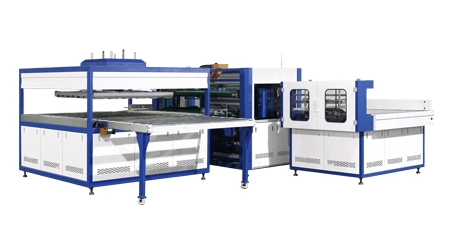
Not all feeding machines are created equal. When evaluating vendor proposals, you must look beyond the price tag and scrutinize the engineering features that dictate performance. The following technical dimensions are critical for ensuring the equipment can handle your specific product mix.
A robust feeding system must be versatile. Your production line likely handles a spectrum of materials, from lightweight packaging foam (6kg/m³) to heavy, viscous orthopedic memory foam (80kg/m³). These materials behave differently under tension. Lightweight foam is prone to stretching or tearing if the conveyor belt moves too aggressively, while heavy foam can cause belt slippage or motor burnout if the torque is insufficient.
Decision Factor: You should prioritize machines with variable frequency drives (VFDs) and adjustable tension controls. These features allow operators to dial in the specific torque required for the material density. Without this adjustability, you risk stretching a Queen-size mattress into a non-standard shape or jamming the line with a heavy block.
Precision is the hallmark of waste-saving foam feeding equipment. The machine must do more than just move the foam; it must position it. High-end systems utilize banks of optical sensors (photoelectric eyes) to detect the leading and trailing edges of the foam block.
Outcome: These sensors communicate with the PLC to center the product relative to the compression platen or cutting blade. This ensures perfectly square cuts and tightly aligned roll-packing. If the sensor technology is inferior, you will see increased waste in packaging film, as the machine compensates for misalignment by using more plastic wrap than necessary.
The interface between the feeder and the compressor is where many systems fail. Standard hydraulic compressors exert up to 80 tons of pressure. When a foam block is fed into this unit rapidly, air must escape quickly. If the feeding and compression are not perfectly synchronized, the foam can "balloon," trapping air pockets that rupture the cell structure or burst the packaging film.
Look for feeding machines that feature rapid air discharge capabilities or "step-compression" modes. This allows the machine to pause momentarily to let air escape before final sealing, preventing product damage during high-speed operations.
| Feature | Standard System | High-Performance System | Impact on ROI |
|---|---|---|---|
| Sensor Type | Basic Limit Switches | Multi-point Optical Arrays | Reduces film waste by centering product accurately. |
| Speed Control | Single Speed / On-Off | Variable Frequency Drive (VFD) | Prevents damage to low-density, fragile foams. |
| Weight Capacity | Up to 40kg | Up to 150kg (High Density) | Enables processing of premium orthopedic mattresses. |
| Control Interface | Button Panel | Touchscreen PLC with Presets | Reduces changeover time between product batches. |
How you implement automation depends on your current factory layout and future scalability goals. There are generally two architectural approaches to deploying a sponge feeding system.
For factories with an existing semi-manual line, retrofitting a versatile sponge feeding system is often the most logical first step. In this scenario, the automatic feeder is placed between the assembly station and the packing machine.
Pros and Cons: This approach has a lower Capital Expenditure (CapEx). However, it requires careful synchronization with legacy equipment. You must ensure that your old cutter or packer can accept the faster feed rate of the new machine. If the downstream machine is too slow, the feeder will constantly start and stop, negating the efficiency gains.
This is the gold standard for high-volume manufacturing. It involves a comprehensive setup: Foaming → Automatic Feeding → Compression → Heat Sealing → Roll Packing. In this architecture, the foam block is never touched by human hands after the initial pour.
Key Component: A critical feature in this setup is auto-splicing. This technology allows the machine to join foam rolls continuously without stopping the line. It enables "endless" feeding, which is essential for maximizing the utilization of large foaming runs. While the initial cost is significantly higher, the labor reduction is dramatic, often allowing a single operator to monitor a line that previously required six people.
Automation requires physical real estate. A standard fully integrated line often requires 20 meters or more of linear space. Before ordering, you must assess your factory layout accurately.
Horizontal Configuration: Ideal for factories with ample floor space. It allows for easy maintenance access and visual inspection of the entire line.
Vertical Configuration: If floor space is tight but ceiling height is generous, some feeding systems can utilize overhead conveyors to buffer stock, dropping them down to the packing line only when needed.
Investing in automation is a financial commitment. To justify the expense to stakeholders, you need a robust framework for calculating Return on Investment (ROI) and Total Cost of Ownership (TCO).
It is important to acknowledge that fully automatic systems command a higher upfront cost compared to simple manual roller conveyors. However, looking at the purchase price in isolation is a mistake. You are buying capacity, consistency, and yield.
To calculate your specific ROI, consider the following inputs:
Scrap Rate Reduction: If automation saves just 3% of your material annually by preventing damage and misalignment, calculate the value of those raw chemicals (Polyols/Isocyanates). For a factory processing tons of foam, this number is often substantial.
Logistics Savings: Connect the feeding efficiency to the compression results. Automated feeding ensures optimal compression alignment, which can lead to a 70% volume reduction in the final package. This directly impacts your shipping costs. If you can fit 20% more units into a shipping container because they are rolled tighter and more consistently, the logistics savings alone can pay for the machine.
TCO includes the ongoing costs of keeping the machine running. Hidden costs often include hydraulic fluid changes, sensor calibration, and belt replacements. However, the lifespan of the equipment is the balancing factor. A well-built machine with robust hydraulics and branded PLC components (like Siemens or Mitsubishi) should provide a 10+ year service life. When amortized over a decade, the annual cost of ownership is often negligible compared to the labor savings.
Due diligence is required when selecting a manufacturing partner. Not all shiny machines deliver on their promises. Here are specific red flags to watch for during the evaluation process.
Be wary of proprietary control systems. Some manufacturers use "black box" software that prevents third-party repairs or integration with other brands. This creates a data silo where your machine cannot communicate with your ERP system or other IoT devices. Always ask if the control architecture allows for open data exchange and if local technicians can access the diagnostic parameters.
Skepticism is healthy when a vendor claims their machine can handle all dimensions without adjustment. In physics, "one size fits all" usually means "fits nothing well."
Verification Step: Do not just accept the spec sheet. Request video evidence of the machine handling your specific minimum and maximum foam dimensions. If you produce 2-meter wide King mattresses and tiny throw pillows, ask to see both being processed. This proof-of-concept will reveal if the "universal" claim holds water.
The most crucial question often comes last: What happens when a part breaks? Does the vendor stock proprietary circuit boards that must be shipped from overseas, or do they use off-the-shelf standard components? A machine that uses standard electrical components (like Schneider or Omron contactors) is far easier to service locally than one relying on custom-printed boards that are out of production.
Integrating an Automatic Sponge Feeding Machine is an investment in margin protection. It shifts your production model from one reliant on manual pacing and susceptible to human error, to one defined by precision and predictability. While the speed gains are attractive, the true value lies in the reduction of waste—both in raw materials and in logistics volume.
Final Verdict: For factories processing high volumes (typically greater than 200 units per day), the reduction in material waste and labor costs typically yields an ROI in under 18 months. The competitive advantage gained by guaranteeing 1-minute cycle times and consistent packaging quality positions your business as a reliable supplier in a demanding market.
Call to Action: Before requesting vendor quotes, we encourage you to audit your current scrap rates. Establish a baseline for how much foam is currently lost to handling damage. Armed with this data, you can demand performance guarantees that ensure your new equipment delivers real bottom-line results.
A: Yes, high-quality machines can handle memory foam, but this requires specific conveyor belts with non-stick properties and adjustable speed synchronization. Standard belts may cause the sticky memory foam to drag or stretch. Ensure the machine features variable tension controls to handle the unique rheology of viscoelastic materials without deforming the product shape.
A: A fully automated line typically requires between 15 and 25 meters in length. This footprint depends heavily on the integration of ancillary equipment, such as the curing oven length and the size of the compression unit. Vertical stacking options may be available for factories with limited floor space but high ceilings.
A: Routine maintenance is essential for longevity. The typical schedule includes daily cleaning of optical sensors to prevent dust signal errors, weekly checks of hydraulic fluid levels and leak inspection, and a monthly calibration of belt tension. Following this schedule prevents minor wear from escalating into major downtime events.
A: Most modern, high-end machines offer IoT connectivity that allows for real-time production tracking and integration with MES/ERP systems. However, this is not always a standard feature on base models. You must specify this requirement in your Request for Quotation (RFQ) to ensure the PLC includes the necessary communication modules (like Ethernet/IP or Modbus).
"


