
Views: 0 Author: Site Editor Publish Time: 2026-05-16 Origin: Site


Waking up with a stiff lower back or aching shoulders ruins your morning before it even begins. This morning stiffness usually points to a severe breakdown in spinal alignment during the night. Your bed should heal you, not hurt you. While memory foam dominates modern marketing campaigns, a pocket spring mattress remains the clinical and orthopedic standard for many chronic pain sufferers—provided they are engineered correctly. The objective reality is straightforward. A quality spring system is highly effective for back pain management, but it is never a universal cure. Its overall efficacy depends heavily on specific technical details. Coil gauge, advanced zoning architecture, and the sleeper's specific weight all play critical roles. You must also account for your primary sleep position. Read on to discover exactly how independent coils target pain and what specifications you should demand before buying.
Targeted Alignment: Independent pocket coils contour to the body's natural curvature, preventing the "hammock effect" that exacerbates lower back pain.
Dynamic Responsiveness: Unlike dense memory foam, pocket springs provide physical pushback, preventing the "stuck" feeling that restricts healthy nighttime movement.
Technical Nuance Matters: Buyers must look beyond marketing terms and evaluate coil gauge (wire thickness), turns per coil, and tempering to gauge actual support quality.
The Hybrid Advantage: For most chronic back pain sufferers, a hybrid configuration (pocket spring base + latex or high-density foam top) offers the optimal balance of orthotic support and pressure relief.
Honest Limitations: A mattress cannot cure structural medical conditions (e.g., herniated discs or arthritis), but a high-quality pocket spring system prevents secondary mechanical pain caused by poor sleep posture.
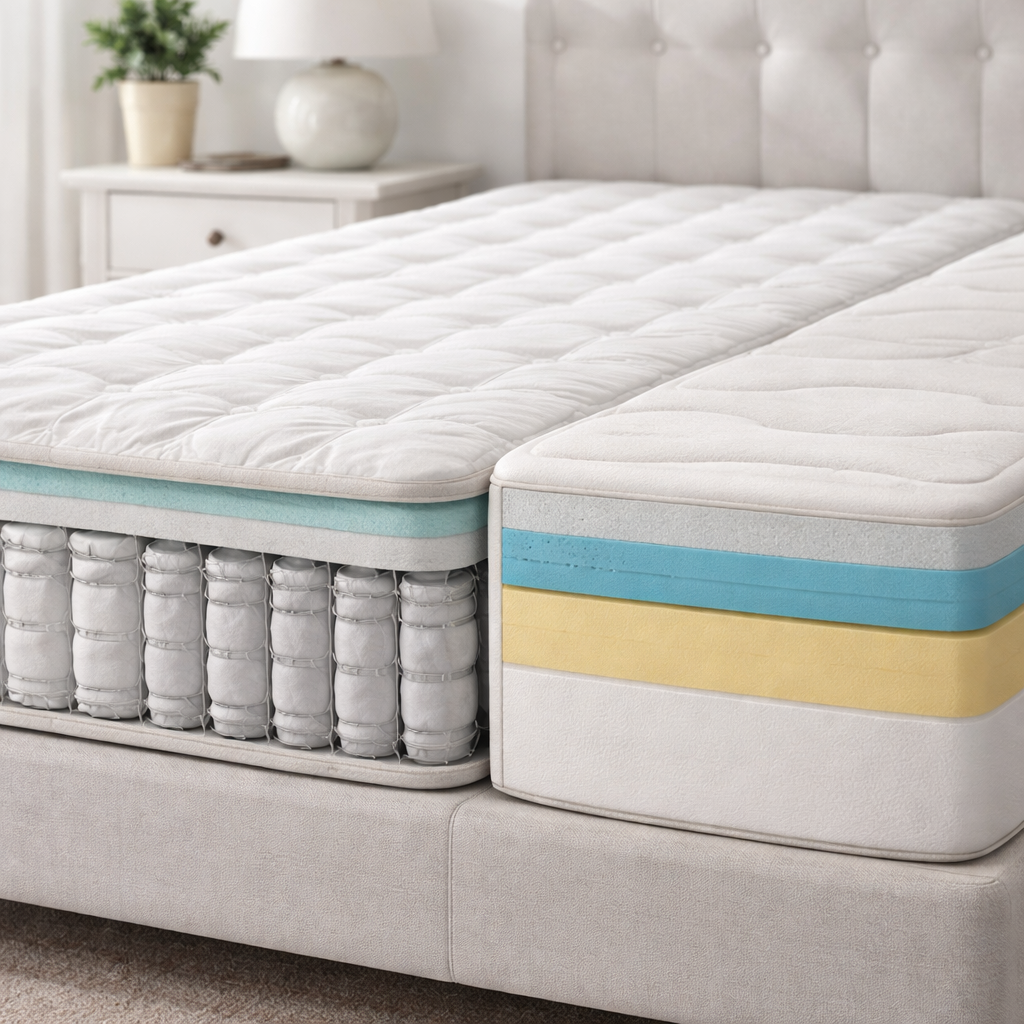
Your spine requires a precise balance of contouring and pushback to fully relax. If a bed fails to deliver this balance, your muscles work overtime while you sleep. They strain to hold your joints in place. This mechanism is exactly where independent coils demonstrate their structural superiority.
Traditional beds tie their springs together. Pocket springs operate entirely alone. Manufacturers encase each coil in its own individual fabric pocket. This isolated design allows each spring to compress only when you apply direct pressure to it. If your heavy hips push down on one zone, the surrounding springs remain uncompressed. They do not pull surrounding springs down. This localized reaction creates a highly accurate mold of your body contour. It essentially maps your physical shape in real-time.
Back pain is rarely uniform. Your upper spine has entirely different mechanical needs compared to your lumbar region.
Upper Back and Shoulders: This area requires significant pressure relief. Side sleepers face the biggest challenge here. The springs must yield enough to let the broad shoulders sink slightly into the bed. If the surface remains too rigid, it forces the neck out of alignment. Maintaining a neutral cervical spine prevents upper back spasms.
Lower Back (Lumbar): Your lower back demands aggressive pushback. Human body weight is heavily concentrated in the pelvis. The springs must resist excessive sinking in this specific zone. If your pelvis drops too deeply, you experience the dreaded hammock effect. This misalignment stretches the lumbar ligaments and creates severe muscular tension by morning.
You should actively seek out advanced zoned support systems. Modern engineering allows manufacturers to place different tensions of springs within the same mattress. They install firmer, lower-gauge coils in the center third of the bed. This specific zone directly supports the heavier pelvic region. Conversely, they place softer, higher-gauge coils at the head and foot sections. This zoning architecture ensures your shoulders compress easily while your hips remain elevated, locking your spine into perfect neutrality.
The mattress industry is crowded with competing materials. You must understand how pocket coils perform against their direct competitors to make an informed choice.
Memory foam changed the industry, but it often fails chronic back pain sufferers in two crucial ways.
First is the "stuck" factor. Foam requires your ambient body heat to contour properly. It physically melts around your shape. It also takes considerable time to rebound once compressed. A pocket spring mattress offers immediate dynamic responsiveness. Springs push back instantly. You can change positions smoothly without fighting your bed. Unrestricted nighttime movement is critical for lubricating joints and avoiding morning stiffness.
Second is the microclimate issue. Chronic pain is heavily aggravated by poor sleep continuity. Dense foams trap body heat aggressively. This leads to frequent, heat-driven micro-awakenings. Pocket springs inherently feature wide-open airflow channels. Air moves freely between the individual fabric pockets, flushing out excess heat and protecting your sleep continuity.
Never confuse modern pocket coils with traditional innerspring beds. Traditional connected coil systems react as one giant, continuous unit.
This creates a dangerous pressure point trap. If your heavy hips push down into a continuous coil bed, the entire wire network bows inward. The springs under your lower back pull down as well, leaving your lumbar curve completely unsupported. This broad bowing effect creates severe pressure points on your hips and shoulders while starving your lower back of necessary support.
Feature | Pocket Springs | Memory Foam | Traditional Innerspring |
|---|---|---|---|
Responsiveness | High (Instant rebound) | Low (Slow response) | High (Bouncy) |
Spinal Contouring | Excellent (Independent) | Excellent (Heat molding) | Poor (Hammock effect) |
Temperature Control | High (Open airflow) | Low (Traps heat) | High (Open airflow) |
Back Pain Efficacy | High | Medium | Low |
We position the hybrid mattress as the most clinically sound compromise for back pain. A true hybrid places premium pocket springs beneath a thick layer of high-density foam or natural latex. This configuration gives you the best of both worlds. The top layers provide plush pressure relief for your joints. The underlying springs deliver the rigorous orthotic pushback your lumbar region requires.
Couples face unique challenges when attempting to manage back pain. A mattress might perform flawlessly for one person but fail miserably for their partner.
Imagine a scenario featuring couples with significant weight differences. One partner weighs 130 lbs, while the other weighs 240 lbs. If they sleep on a traditional foam or continuous spring bed, disaster strikes. The heavier partner compresses the center of the bed deeply. This creates a massive structural slope. The lighter partner spends the entire night subconsciously fighting gravity to avoid rolling into the middle. This isometric muscle strain is a major hidden cause of morning back pain.
Independent coils effectively sever the transfer of kinetic energy across the sleeping surface. When the heavier partner tosses or turns, the localized springs absorb the shock. They do not transmit that kinetic energy through the wire network. The lighter partner remains entirely undisturbed.
More importantly, pocket springs guarantee shared alignment. Because the coils react individually, they adapt to each person's unique mass. The heavier partner gets the deep, robust support they need to keep their spine straight. Simultaneously, the lighter partner engages just the top portion of the coils on their side. Both individuals maintain perfect posture without compromising each other's sleep surface.
Do not rely on flashy marketing terms to manage your back pain. You must interrogate the technical specifications of the bed. Use this numerical framework to evaluate any potential purchase.
Coil Gauge (Wire Thickness)
Gauge measures the physical thickness of the steel wire. This number operates on an inverse relationship. A 12-gauge wire is exceptionally thick, creating a very firm sleep surface. A 15-gauge wire is much thinner, yielding a softer, more plush feel. We strongly recommend aiming for a 13 to 14.5-gauge coil system. This specific range provides the optimal medium-firm back support necessary for most adults.
Coil Count & Turns
Many brands use massive coil counts purely for marketing hype. They cram thousands of miniature springs into the bed, which often degrades structural integrity. You should emphasize "turns per coil" instead. A higher number of turns—meaning more twists in the actual steel wire—indicates a superior spring. These highly twisted springs adapt more smoothly to your body shape and offer far greater long-term durability.
The "Bed-in-a-Box" Edge Support Risk
You face a significant implementation risk with modern online mattresses. Many roll-up boxed mattresses intentionally remove heavy-duty steel edge support. They do this simply so the bed can be crushed and compressed down into a shipping box. Edge support is absolutely vital for back pain sufferers. A firm perimeter provides a stable launchpad for safely getting in and out of bed. If the edge collapses beneath you, it jars your spine and triggers immediate lower back spasms.
There is no universally perfect mattress. Your body weight and your primary sleep position dictate exactly what type of pocket spring system you require.
Sleeper Profile | Ideal Mattress Configuration | Why It Works |
|---|---|---|
Lightweight (<130 lbs) | Hybrid with thick comfort layer and higher gauge (softer) coils. | Standard springs may feel too rigid. Needs plush top to engage coils properly. |
Heavyweight (>230 lbs) | Strictly pocket springs. Lower gauge (thicker) steel coils. | Prevents bottoming out. Delivers strong upward pushback for lumbar support. |
Back Sleepers | Medium-firm pocket springs. Zoned support. | Maintains natural spinal curvature without over-arching the lower back. |
Side Sleepers | Hybrid setup. Deep top layers over supportive coils. | Absorbs the shoulder and hip before they hit the firm coil base. |
Stomach Sleepers | Firmest possible pocket spring tension. Minimal top padding. | Prevents heavy hips from sinking and hyperextending the lower spine. |
If you weigh under 130 lbs, you may find standard pocket springs far too firm. You lack the mass necessary to compress the steel. You require a hybrid with a thicker, softer comfort layer to help you engage the underlying springs. If you weigh over 230 lbs, pocket springs are strictly necessary over all-foam alternatives. Foam simply bottoms out under high pressure. You demand lower gauge steel coils to maintain elevation throughout the night.
Back sleepers are the best candidates for standard medium-firm pocket springs. This position naturally distributes weight evenly. Side sleepers must seek out a hybrid setup. The top foam layers must be thick enough to fully absorb the projecting shoulder and hip before the body hits the firm coil base. Stomach sleepers need the firmest possible tension. If a stomach sleeper's hips sink even an inch, their lower back violently hyperextends backward, causing acute morning pain.
You must approach your mattress purchase with clear, objective boundaries. We must establish trustworthiness by explicitly stating what a mattress can and cannot do.
No mattress is a recognized medical device. A bed will never cure degenerative disc disease. It will not heal sciatica. It cannot reverse age-related arthritis. You must reject any marketing material that promises miracle medical cures. If you suffer from severe structural spinal issues, you must consult an orthopedic specialist first.
The mattress serves purely as an orthotic foundation. Its only job is to remove environmental friction from your healing process. A high-quality pocket spring system prevents the secondary muscle spasms and joint stiffness that result from fighting a sagging sleep surface. When you sleep on an overly rigid or heavily degraded bed for eight hours, your muscles unconsciously brace themselves. The right springs eliminate this bracing effect. They allow your soft tissues to regenerate peacefully.
A pocket spring mattress remains an exceptional tool for mitigating nighttime discomfort. When built into a high-quality hybrid design, it is arguably the most structurally sound choice for back pain. Its independent contouring handles shoulder pressure beautifully, while its robust steel core delivers the rigid pushback your lumbar region desperately needs.
Your next steps require strict discipline. Do not settle for basic models. Advise your salesperson that you prioritize beds with built-in Zoned Support. Check the manufacturer's coil gauge specifications directly. Ensure the bed features reinforced steel edge support to protect your morning transitions. Finally, always demand a trial period of at least 90 days. It takes considerable time for your existing spinal musculature to unlearn bad habits and adjust to proper orthotic alignment.
A: Quality tempered steel pocket springs generally provide consistent, reliable support for 7 to 10 years. Because the springs are heat-tempered and act independently, they outlast basic foam materials significantly. However, you must rotate the mattress every six months to ensure even wear across the central zones.
A: No. The "harder is better" myth is dangerous. If the bed is too firm, your shoulders and hips cannot sink in. This forces your lower back into an unnatural, unsupported bridge. You need medium-firm support to allow proper sinking for natural spinal alignment.
A: Yes, but individual coil flexibility matters heavily. Highly rigid traditional springs cannot bend without breaking. However, independent pocket coils paired with flexible foam edges typically articulate perfectly with modern adjustable bases, enhancing your pain relief options.
A: No. Modern foundation requirements have changed. Rigid slatted bases or solid platform beds are strongly preferred. Traditional flexing box springs can actually undermine the targeted, independent support of pocket coils by creating an unstable, bowing foundation underneath them.


