
Views: 0 Author: Site Editor Publish Time: 2026-01-07 Origin: Site


In modern mattress manufacturing, automation has revolutionized cutting, quilting, and packaging. Yet, many hybrid production lines still suffer from a critical bottleneck in the middle: the assembly and layering stage. Operators often struggle to manually align large, flexible foam sheets at the speed required by downstream gluing and compounding equipment. This disconnect creates a "stop-start" rhythm that caps total daily output and introduces human error into the core structure of the mattress.
The Automatic Sponge Feeding Machine represents the solution to this integration gap. It is not merely a conveyor belt; it is an intelligent link between raw material preparation and final assembly. By synchronizing the flow of materials, these machines ensure that the pace of production is dictated by system capacity rather than human fatigue. This article provides a technical evaluation of efficiency gains, integration requirements, and ROI analysis to help you determine if this equipment is the right investment for your facility.
Labor reduction: Automated feeding typically replaces 1–2 manual operators per shift, directly impacting margins.
Quality control: Vision-guided positioning eliminates "misalignment" errors common in manual foam layering.
Throughput synchronization: Matches the speed of upstream cutting and downstream gluing lines, removing production pauses.
Safety: distances operators from heavy lifting and repetitive strain injuries.
For factory managers, identifying the exact moment when manual processes become a liability is crucial. While human operators offer flexibility, they lack the consistency required for high-volume manufacturing. The breakdown usually occurs not in a single catastrophic failure, but in the accumulation of micro-inefficiencies throughout a shift.
The primary symptom of a feeding bottleneck is the "stop-start" inefficiency. In a manual setup, the gluing machine often runs idle while operators retrieve, separate, and align the next sheet of foam. Over an eight-hour shift, these idle seconds accumulate into hours of lost production time. Furthermore, handling large foam sheets—often measuring 200cm x 200cm—is physically demanding.
By the sixth hour of a shift, operator fatigue sets in. The pace naturally slows, and the alignment precision drops. Industrial foam feeding equipment does not suffer from fatigue. It maintains a constant cycle time from the first minute of the shift to the last. If your gluing line is capable of processing five units per minute but your team can only sustain three, your manual feeding process is actively costing you revenue.
Speed is not the only metric; accuracy is equally vital. In hybrid mattress construction, multiple layers of foam with varying densities are stacked. A seemingly minor misalignment of 5mm in the base layer can result in a "compound error." By the time the third or fourth layer is applied, the misalignment may grow to 20mm, resulting in a rejected finished product or a mattress with comprised structural integrity.
This issue is exacerbated by the nature of the materials. Viscoelastic memory foam and natural latex are notoriously difficult to handle manually. They stretch, deform, and tear if grabbed too aggressively. Human operators, rushing to keep up with a conveyor, often inadvertently stretch the edges of the foam during placement. Once the glue sets, the foam retracts, causing the mattress to curl or warp. Automated feeders utilize synchronized gripping systems that handle these delicate materials without inducing stress, ensuring the layers remain flat and true to size.
Manual feeding places workers in close proximity to heavy machinery and adhesive application zones. The repetitive motion of lifting heavy, awkward foam sheets is a leading cause of musculoskeletal disorders in the bedding industry. Additionally, relying on manual labor near glue rollers increases the risk of chemical exposure and mechanical accidents. Automating this zone allows you to distance operators from these hazards, moving them to supervisory roles that are safer and add higher value to the production process.
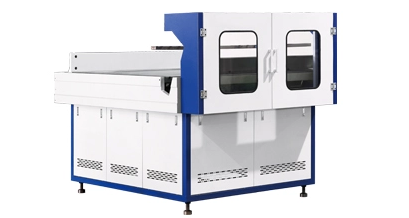
Modern feeding systems have evolved far beyond simple belt drives. They now incorporate sophisticated robotics and sensing technologies designed specifically for the unique properties of polyurethane foam.
The most significant advancement in this sector is the integration of vision systems. High-speed optical sensors and cameras scan the incoming sponge layer as it approaches the placement zone. These systems detect the edges and corners of the material to calculate its exact orientation (X, Y, and Theta coordinates).
If a sheet is approaching at a slight angle, standard conveyors would simply feed it crookedly. However, advanced machines feature "correction compound" capabilities. Using the data from the vision system, the machine automatically adjusts the layer's angle via servo-controlled alignment belts or robotic arms before it is placed onto the mattress core. This ensures perfect alignment every time, regardless of how the material was originally loaded onto the line.
Foam is porous and often slippery, making it difficult to transport efficiently. Standard rubber belts often fail to generate enough friction without crushing the material. To solve this, manufacturers utilize specialized labor-saving mattress machinery equipped with adaptive gripping technologies.
Two common mechanisms dominate the market:
Vacuum Grippers: These use suction to lift and hold the foam. They are ideal for denser foams but require calibration to avoid sucking through highly porous materials.
Needle Grippers: These use fine, retractable needles to pierce the surface layer of the foam for a secure hold. This is particularly effective for heavy or slippery layers.
A critical feature to look for is "Flexible Clamping." This technology ensures that the edges of the foam are held down during high-speed movement, preventing the "dog-ear" curling effect that often causes jams in downstream machinery.
An automatic feeder acts as the brain of the assembly line's front end. It must communicate seamlessly with upstream precise sponge cutting machines. Through Manufacturing Execution Systems (MES) or SCADA integration, the cutting machine can signal the feeder that a SKU change is occurring—for example, switching from a King size memory foam layer to a Twin size high-density base.
The feeder receives this data and automatically adjusts its guide rails, speed, and gripping parameters without requiring a manual reset. This digital handshake eliminates the downtime typically associated with product changeovers, allowing for "batch size one" production flexibility.
Investing in automation requires a clear business case. Below, we break down the three main pillars of Return on Investment (ROI) for sponge feeding technology.
The most immediate impact is on headcount. A manual feeding station typically requires two operators: one on each side of the line to lift and guide the sheets. An automated solution generally requires only one operator to supervise the line and replenish stacks, and in fully integrated systems, this operator can manage multiple machines simultaneously.
Estimated Annual Savings Calculation:
| Cost Factor | Manual Process | Automated Process | Impact |
|---|---|---|---|
| Labor Headcount | 2 Operators | 0.5 Operator (Shared) | -1.5 FTE Savings |
| Throughput (Units/Shift) | 400 (Variable) | 600 (Constant) | +50% Capacity |
| Scrap Rate | 3% - 5% | < 0.5% | Significant Material Savings |
Material costs often exceed labor costs in mattress manufacturing. Foam that is torn during manual handling or scrapped due to misalignment represents a direct leak in profitability. When a foam layer is glued incorrectly, the entire assembly—including the expensive pocket spring unit and other foam layers—may need to be discarded or sold as a "second."
By reducing the scrap rate from an industry average of 4% down to below 0.5%, the machine contributes directly to lowering the Total Cost of Ownership (TCO). For high-volume factories, the savings in material waste alone often cover the machine's depreciation cost within the first 18 months.
Automation introduces "Cycle Time Consistency." Humans vary in speed; machines do not. A consistent feed rate stabilizes the entire production line, allowing downstream equipment like roll-packing machines to operate at optimal speeds without buffering or waiting. This stability allows for more accurate production planning and promised delivery dates.
Not all feeders are created equal. When vetting suppliers, use the following criteria to ensure the equipment matches your specific production needs.
The primary decision factor is the machine's range. Can it handle your entire inventory? A robust machine must feed high-density base foam (rigid and heavy) as effectively as it feeds delicate, 1cm thick viscoelastic memory foam. Ask specifically about the "thickness range." Feeding thick slabs is easy; feeding ultra-thin layers without crumpling them requires advanced belt control and vacuum regulation.
Before purchasing, assess your site readiness.
Site Planning: Measure the physical space carefully. Feeders are often long to accommodate the alignment zones. Ensure there is clearance for forklift access to load raw stacks.
Power & Logic: Verify compatibility with your factory's voltage standards. Furthermore, check the brand of the PLC (Programmable Logic Controller). Using a brand that your maintenance team is already familiar with (e.g., Siemens, Mitsubishi, or Omron) will significantly reduce troubleshooting time.
Foam cutting and handling generate dust and static electricity. This environment is hostile to sensors. Look for machines with "self-cleaning" features for their optical lenses and sealed bearings for moving parts. Modular belt designs are also a best practice; they allow your maintenance team to replace a single damaged section of the belt rather than the entire conveyor loop, reducing spare part costs.
While the benefits are clear, improper implementation can lead to frustration. Avoid common pitfalls by following these strategic guidelines.
Beware of buying high-speed feeders for low-volume lines. If your factory produces highly customized mattresses requiring frequent, complex material changes that the machine cannot handle automatically, the setup time might exceed the run time. Automation shines in high-volume, low-mix environments or high-mix environments with fully integrated digital data flow.
Power Supply Stability: The servo motors and vision systems that drive precision require clean, stable power. Voltage spikes can cause sensor errors, leading to "ghost" misalignments. Installing dedicated voltage stabilizers for the feeding line is a recommended best practice.
Dust Control: Static-charged foam dust loves to stick to camera lenses. Ensure that your installation plan includes integrating dust extraction hoods around the feeding zone. Regular cleaning protocols must be established from day one to prevent sensor blockage.
Implementing this technology requires a cultural shift. You are moving your workforce from "manual lifters" to "machine supervisors." Training should focus on parameter adjustment, troubleshooting alarm codes, and basic sensor maintenance. Empowering operators to own the machine's performance is key to long-term success.
The transition to an Automatic Sponge Feeding Machine is no longer an optional luxury for factories aiming for digital transformation. For any facility targeting a consistent daily output of over 200 units, the reliance on manual feeding is a verifiable bottleneck that bleeds efficiency and quality.
When selecting your equipment, prioritize intelligent visual correction and robust software integration over purely mechanical speed. The ability to integrate with upstream cutting data and downstream assembly logic will define the future-readiness of your line. We encourage you to audit your current "scrap rates" and "handling time" today. The data will likely reveal that the cost of inaction exceeds the investment in automation.
A: The footprint varies by model, but typical units require a length of 4 to 6 meters to allow sufficient distance for the vision alignment systems to operate. You must also account for roughly 2 meters of clearance on the loading side for forklift or AGV access. Always request a CAD layout from the manufacturer to overlay on your current factory floor plan.
A: Yes, advanced models can handle a wide range of densities, from lightweight memory foam to heavy base foam. However, they typically process one type of sheet at a time. The machine parameters (grip strength, speed) may need to auto-adjust between layers if the density difference is extreme. Ensure the machine's software supports "recipe" storage for quick switchovers.
A: Daily maintenance usually involves wiping down optical sensors and blowing off foam dust. Weekly checks should focus on belt tension and gripper integrity. Monthly or quarterly schedules should include checking servo motor calibration and lubricating moving parts. A well-maintained machine can run for years with minimal downtime.
A: While they can operate as standalone units, they perform best when paired with CNC contour cutters or horizontal slitters that can output digital production data. If your upstream cutter is manual, the feeder will rely entirely on its own sensors to detect the foam size, which works but is slightly less efficient than a fully integrated data link.
A: If the machine is equipped with a vision alignment system, it will detect the skew. The system calculates the correction angle and uses differential belt speeds or a robotic alignment arm to rotate the foam into the correct orientation before it reaches the final placement or gluing point.
"


